
Meet the Airbus UTM “Prototype”
As part of the Airbus organization, it is in our DNA to ensure that the UTM system we develop and deploy is designed to serve a broad spectrum of stakeholders for both today’s airspace, and the increasingly complex and crowded airspace of tomorrow.
Solving problems in an airspace that doesn’t yet exist is challenging – but visualizing those conditions in a simulation environment is one way to understand what that future airspace will look like. At Airbus UTM, we use our unique simulation tool to explore and evaluate concepts, services, and architectures that will serve as critical foundation pieces of a robust and future proof UTM framework.
The simulation tool shaping the UTM systems of the future
More specifically, we use the Prototype to develop a set of sustainable and forward-looking safety critical tools and services to support advanced concepts like urban air mobility, wide scale drone delivery in urban areas, or automated flight beyond visual line of sight (BVLOS). The simulation environment allows researchers to explore these advanced concepts in an astoundingly complex future environment: one that may include not only high volumes of traffic, but also new regulatory requirements and policies that have yet to be enacted.
UTM concepts like deconfliction, for example, are complex problems that become even more critical in dense airspace. Simulation can allow researchers to develop and test deconfliction strategies that move beyond pairwise deconfliction and consider the problem of maintaining efficient flight paths while avoiding conflicts from multiple directions at once.
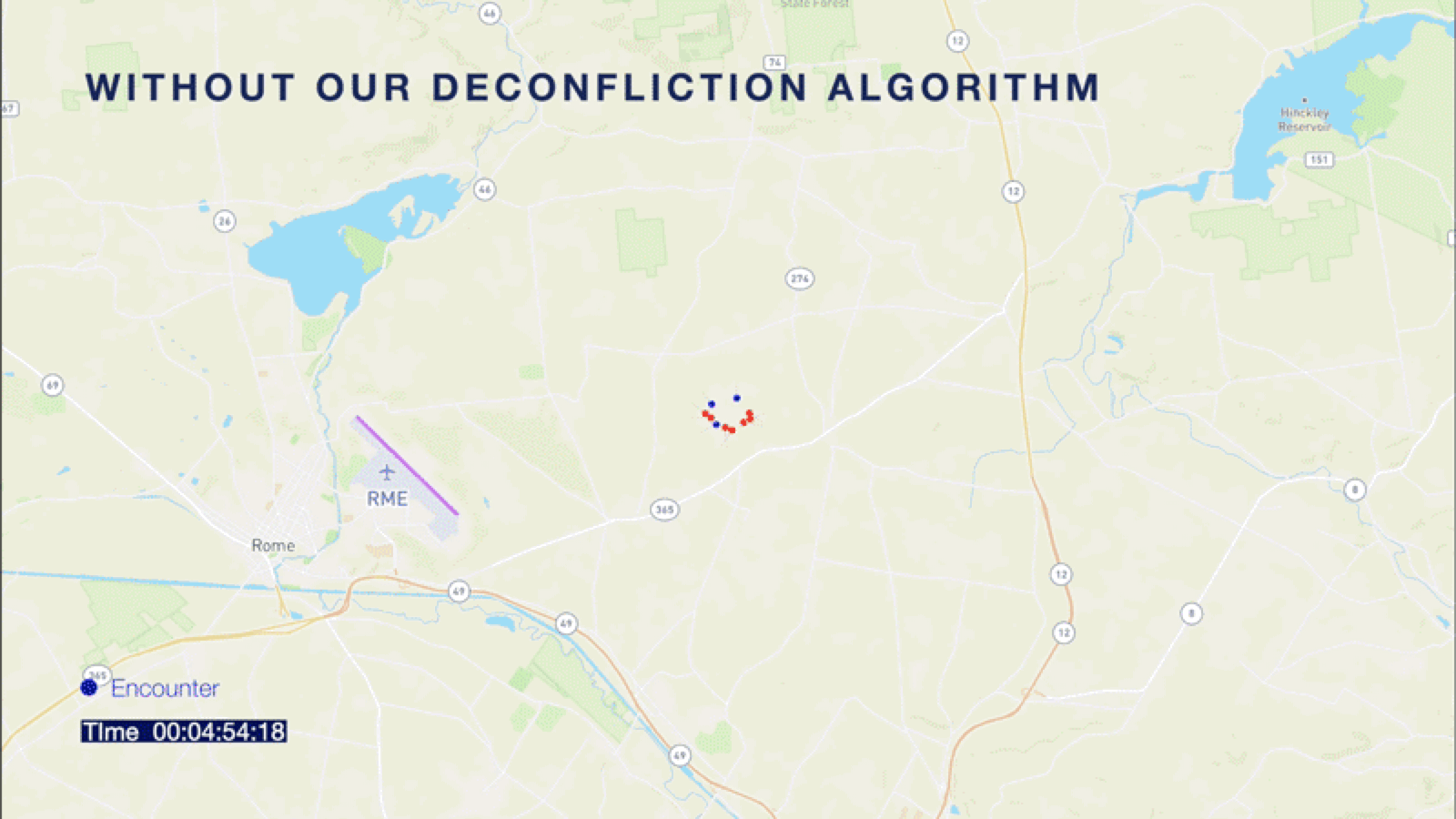
We also use simulation to explore interoperability, by considering the effects of having many operators and USS stakeholders in the system, each with their own business interests and each attempting to optimize their operations in shared airspace. Through this understanding, we explore concepts of fairness: What happens when one operator reserves a disproportionately large amount of airspace? How is priority negotiated?
One of the first efforts kicked off within Altiscope, the Acubed project that became Airbus UTM, was the development of a dynamic simulation tool the team called “The Prototype.” In those early stages, the Prototype was designed to explore ideas about the basic requirements of UTM: concepts like fairness and deconfliction, which the UTM community was still defining at the time.
Today, the Prototype is a distributed, service-based system that can simulate everything from the physics of an aircraft to the wide variety of factors that impact flight: like weather, infrastructure, and other nearby vehicles. Layered over this is a component that simulates the UTM system itself. The Prototype, using the Airbus UTM cloud platform, can simulate hundreds of thousands of flight hours in under a day, identifying anomalies and providing reliable and reproducible results.
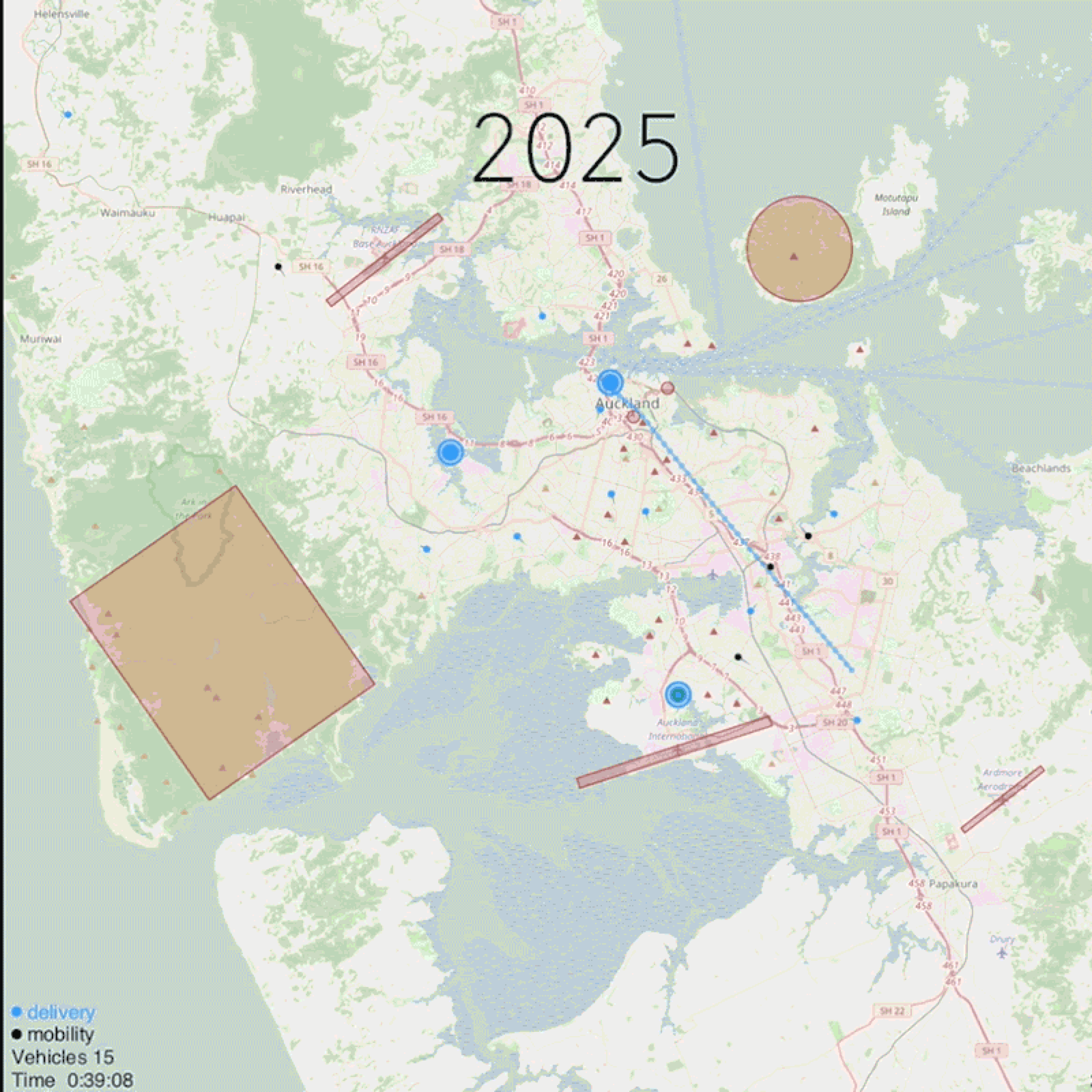
The Airbus UTM tools and simulation environment are at work for the entire aerospace industry, providing valuable data to inform industry standards and gain a global consensus on what the airspace of the future will look like. We are committed to making our research and algorithms available to the community, to enable the development of traffic management systems that will support the whole airspace ecosystem.
Technical papers shaped by the Prototype
- Encounter Aware Flight Planning in the Unmanned Airspace – a novel algorithm combining strategic demand-capacity balancing with 4D trajectory planning for UTM operations.
- Optimizing Collision Avoidance in Dense Airspace using Deep Reinforcement Learning (ATM R&D Seminar 2019, with Stanford University).
- Fairness in Decentralized Strategic Deconfliction in UTM (SciTech 2020).
- Unlicensed Technology Assessment for UAS Communications (ICNS 2020).
- Tradeoffs between Efficiency and Fairness in Unmanned Aircraft Systems Traffic Management (ICRAT 2020, with MIT).